
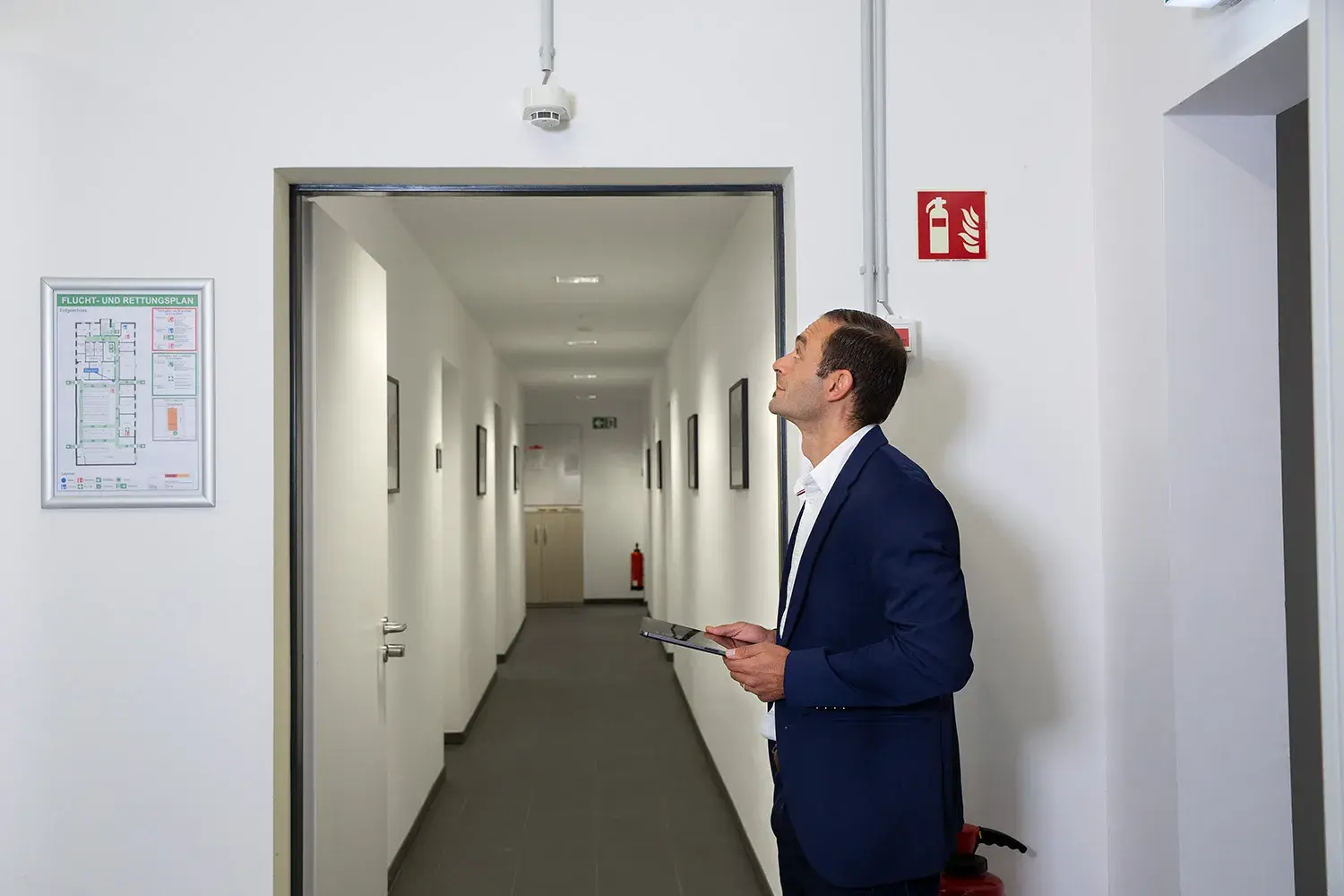
What is a fire safety inspection?
A fire protection inspection comprises the regular inspection of measures in structural, technical and organizational fire protection within a workplace. It is part of preventive fire protection.
The reason for this is that experience has shown that buildings are subject to constant changes in use, hazards and construction during their service life. In addition, changes in fire protection and labor regulations are possible. Consequently, the fire protection precautions in the building must be regularly checked to ensure that they are up to date, meet their objectives and are functional. In addition to checking the structural and technical condition of the fire protection equipment, this also includes the company's internal organization in the event of a fire through a sufficient number of fire protection and evacuation assistants as well as sufficient fire protection knowledge of the employees.
Is it mandatory to conduct a fire safety inspection?
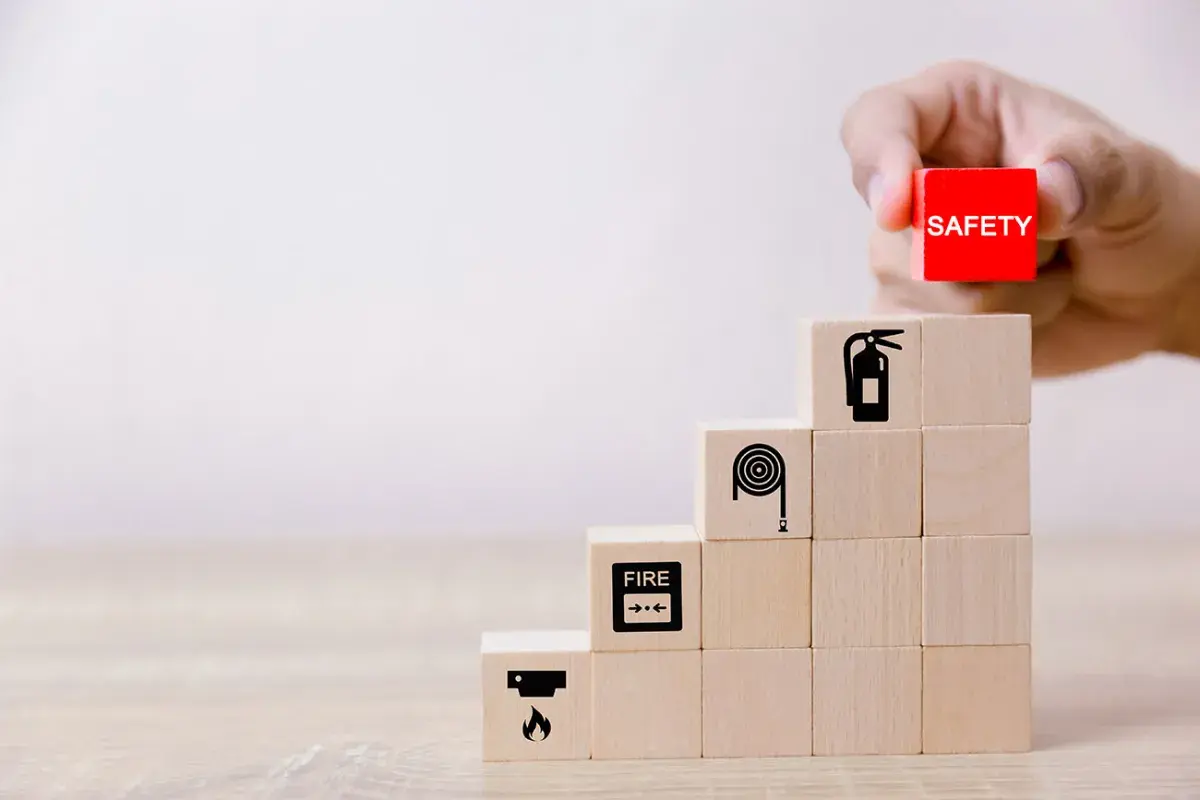
According to Section 10 of the Occupational Health and Safety Act, the employer must ensure that fires are prevented, fought and employees and other persons evacuated in the event of a fire. At the same time, according to Section 10 (2) ArbSchG, the employer must appoint fire protection and evacuation assistants who will be responsible for initial firefighting and evacuation of the building (before the fire department arrives) in the event of a fire. In addition, the employer must take, enforce and regularly monitor preventive fire protection measures on the basis of a risk assessment. The fire safety inspection is used to check these individual requirements for the company, and to discover and eliminate possible deficiencies.
Who is responsible and allowed to conduct fire safety inspections?
The employer or contractor is responsible for the correct performance of a fire safety inspection. The employer can delegate the resulting duties to internal or external fire protection officers who have the necessary expertise. The inspection is carried out by the employer or an appointed person. It is thus an integral part of the duties of a fire protection officer. In addition, for buildings with a high level of complexity or fire hazard, an inspection with representatives of the local fire protection service / fire department or fire protection specialist planners may be necessary.
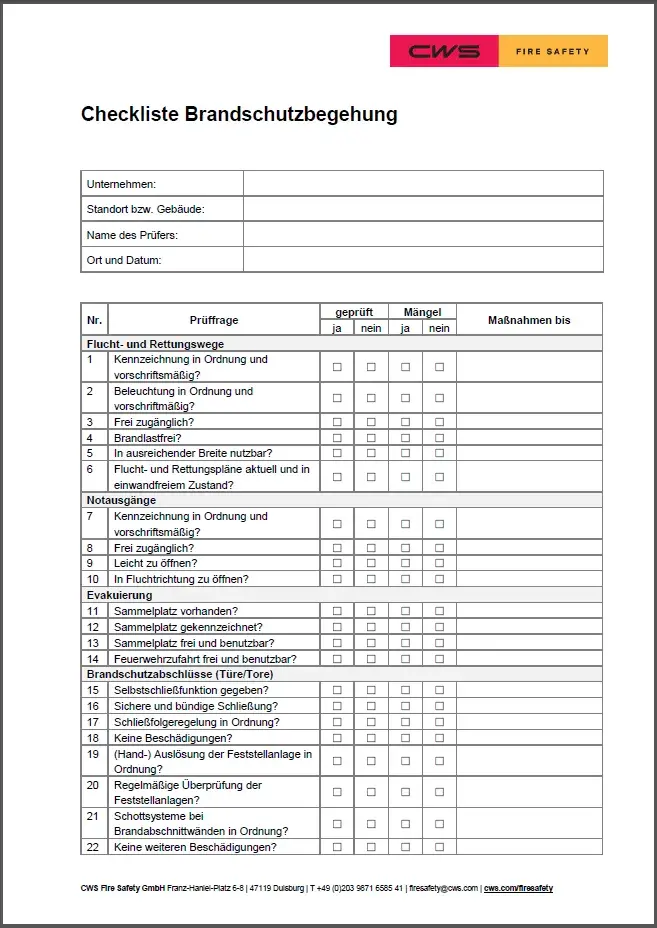
Checklist fire safety inspection (in German)
Keep all the necessary points in mind during your next fire safety inspection. Download your free fire inspection checklist here.
How often and for which buildings is a fire safety inspection required?
Basically, inspections are necessary for all buildings. The frequency and significance of the inspection depends on the individual fire hazard in the building and the risk to persons in the event of an emergency. The following guide values apply:
Small and medium-sized enterprises with no particular risk: At least every 2 years
Large companies and companies with increased fire risk: Individual and close-meshed inspection cycles, which are at the discretion of the company.
Companies with a lot of public traffic, e.g. places of assembly and companies with a high fire risk (e.g. due to hot work): daily to weekly depending on individual circumstances.
In general, it is advisable to conduct a full fire safety inspection at least once a year. In addition, regardless of the size of the company, weekly inspections of the building are advisable to reduce risks in the event of a fire (e.g., due to a detected fire door or objects in the escape route).
How to plan and prepare for a fire safety inspection?
A fire protection inspection must be carefully planned to take into account all fire protection equipment in the building and to ensure comparability. Checklists that summarize all important points in a compact manner are helpful for this purpose. Basically, an inspection includes the following points and requirements:
1. Escape and rescue routes
The safety and passability of escape and rescue routes must be ensured at all times. This means that they must comply with the width and nature of the building code. They must be kept clear at all times and must not be used for storage or stowage, especially of combustible materials. Emergency exits must open easily and not be blocked. In addition, escape routes must be adequately illuminated and marked.
2. Fire protection closures
Fire doors and gates (including hold-open systems) must be checked for integrity, functionality, tightness and flushness. This includes the release of the hold-open systems with test smoke and the testing of the automatic closing mechanism. The latter is often impaired in everyday life because fire doors are held open with wedges, for example (which is not permitted!).
3. Fire protection equipment
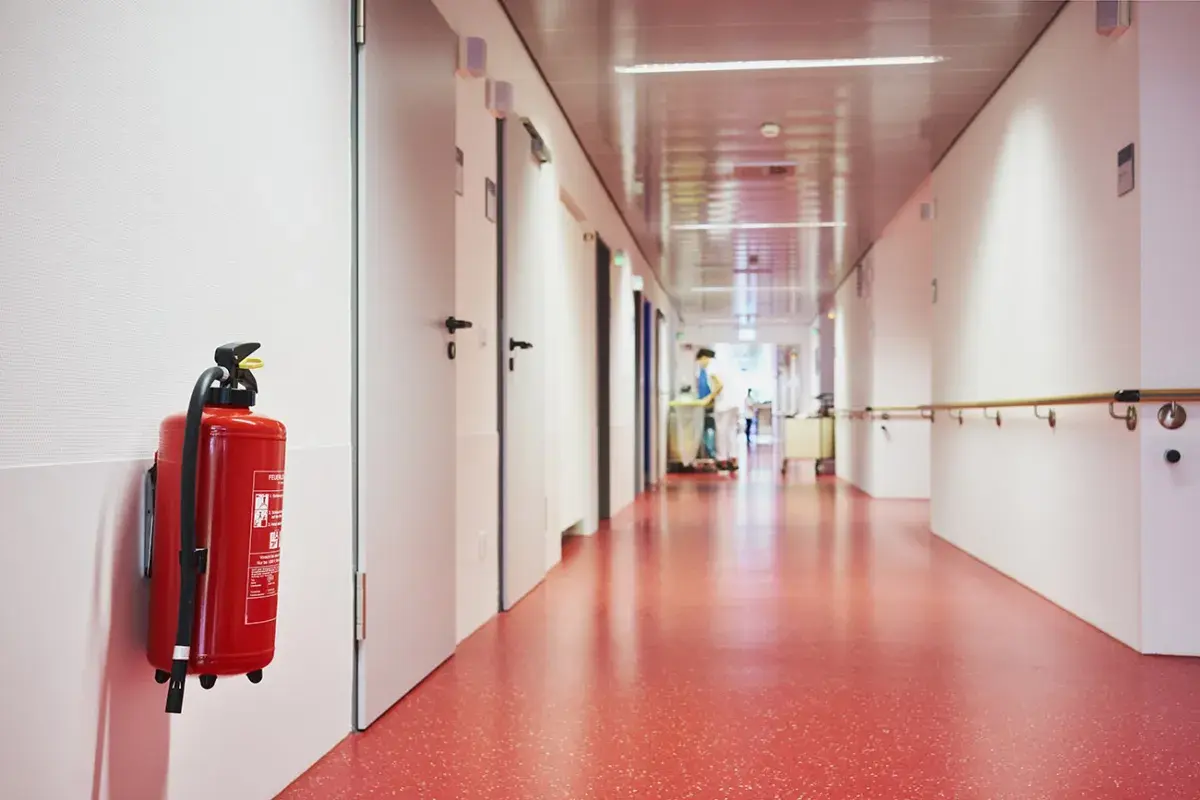
The test includes the presence and functionality of the necessary fire protection equipment. This includes, in particular, fire extinguishers and wall hydrants for initial fire fighting. These must be in their original condition, i.e. sealed, without external damage and with a current test certificate.
4. Alarming devices and emergency shutdowns
Manual pushbutton detectors for triggering a fire alarm system and alerting the fire department, emergency shutdowns for machines, and manual release buttons for extinguishing systems or smoke heat extractors must be accessible and recognizable at all times.
5. fire safety knowledge of the employees
It must be checked whether all employees have sufficient knowledge of the correct behavior in the event of a fire and whether fire protection exercises and instructions have been carried out. In addition, a sufficient number of fire protection and evacuation assistants must be trained and appointed.
It is advisable to check all necessary fire protection-related documents such as fire protection regulations, fire protection plans, protocols on the testing of electrotechnical and safety equipment or fire protection instructions in advance for completeness and up-to-dateness.
How is the fire inspection to be documented? What is the purpose of the protocol?
The results of a fire protection inspection must be documented in a protocol. This serves as proof of the inspection of the fire protection facilities and the employer's fulfillment of obligations vis-à-vis the authorities and insurance companies. It is particularly important after a fire incident and is considered evidence in court to establish responsibility for a fire in the company. In addition, it serves to discuss the results with the employees in order to jointly remedy organizational deficiencies. The protocol must be compiled carefully and in a way that is comprehensible to third parties. It must contain the following points:
- Date of the fire safety inspection
- Participating persons
- List of inspected objects
- Applicable fire protection requirements
- Inspection result per object
- In the case of deficiencies, the protocol must show details of the deficiencies, measures for eliminating the deficiencies, and a date for implementation and inspection.
How and by when must a defect be remedied?
Deficiencies identified during the fire safety inspection must be remedied as soon as possible in order to restore safety in the building and for employees as quickly as possible. There is no fixed time limit or obligation to carry out a follow-up inspection to rectify the deficiencies. The deadline, the date of the follow-up inspection and the successful rectification of defects shall be recorded in the protocol.
What happens if defects are not corrected?
If the identified deficiencies are not corrected, complete fire protection in the building is not guaranteed and the employer does not fulfill his obligations to the authorities and insurance companies. In the event of a fire, the employer will be held responsible for known deficiencies in structural, technical and organizational fire protection, and insurance coverage may be voided.
When correcting deficiencies, it is helpful to work with experts in the field to ensure operational safety as quickly as possible. Our fire protection experts support the internal fire protection officers before, during and after a fire protection inspection. At the same time, this responsible task can be transferred by appointing an external fire protection officer from CWS.
Checklist fire safety inspection (in German)
Keep all the necessary points in mind during your next fire safety inspection. Download your free fire inspection checklist here.
Do you have any questions about fire safety inspections?
Get in touch with us. We are available to advise you with our comprehensive expertise.